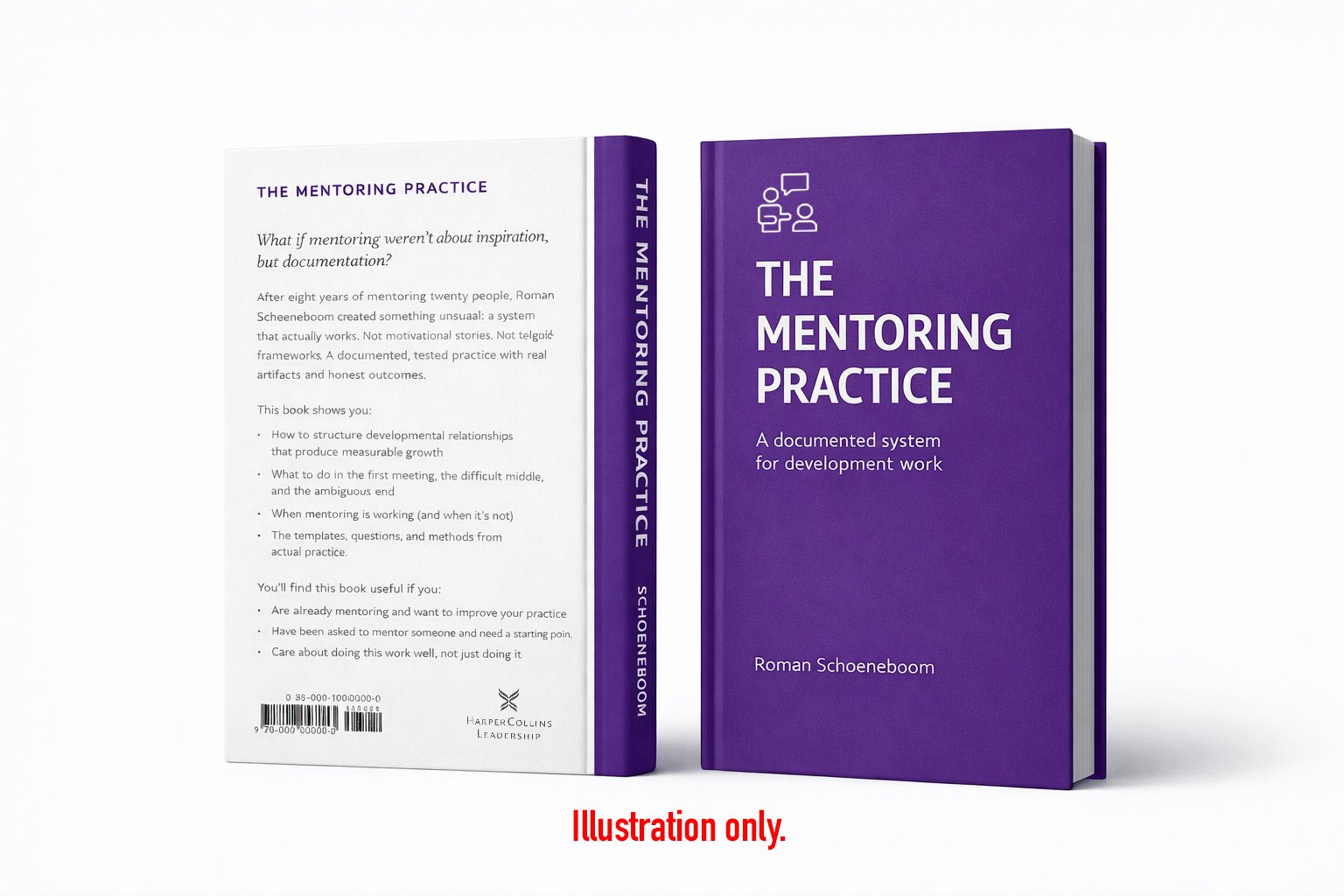
The Mentoring Practice
A documented system for development work
Mentoring is often treated as conversation or inspiration.
This practice approaches it as structured work — designed, tracked, and continuously refined.
Scope of Practice
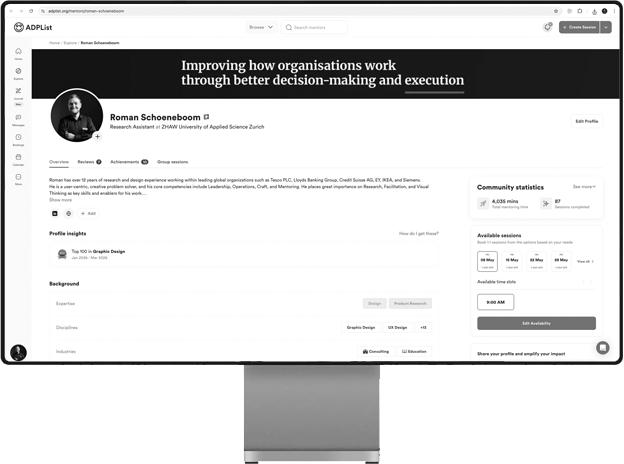
Since 2017, I’ve been mentoring individuals across different stages of their careers — from early transitions into UX to senior practitioners working on design leadership and organisational challenges.
The work spans:
Years of practice: since 2017
Formats: 1:1 mentoring, cohort programs, community platforms
Contexts: independent work, UX communities, structured programs
Geographies: mentees across Europe, Africa, North America, and beyond
Platforms: including ADPList and community-led initiatives
Rather than focusing on volume alone, the practice tracks depth and applicability:
Each session is evaluated based on how useful it was in real work — not just how it felt in the moment.

The practice is tracked over time — not just by volume, but through documented engagements, structured sessions, and observable progress.
Countries
global reach
Programs & Communities
ADPList Mentor
recognised
Completed engagements


3000+
25+
Mentorship minutes
structured sessions
People mentored
across career stages
7+
10+
19 / 24
Top 1%
Engagement outcomes
Out of 24 documented mentoring engagements:
19 reached formal completion — with defined goals, applied work, and structured checkout
5 ended earlier due to changing priorities or context
Not all mentoring relationships are designed to complete.
Some end when clarity is reached.
Completion reflects applied progress — not just whether time was spent, but whether the work moved forward.








How the Practice Works
This is not advice-led mentoring.
It’s a structured process focused on helping people move forward through clarity, artefacts, and application.
1. Orientation →
We define goals, context, and constraints.
Not “what do you want to do?” — but what are you actually trying to move forward right now?
2. Structuring →
Ambiguity is broken down into concrete problems.
This often involves reframing assumptions and identifying what’s really blocking progress.
3. Artefact Creation →
Instead of discussing ideas abstractly, we create tangible outputs:
CVs, Portfolios, and Case studies
Positioning Strategies and Decision Frameworks
4. Feedback & Iteration →
Work is reviewed critically and refined.
The focus is on improving thinking and execution — not just validating effort.
5. Application →
The work is applied in real contexts:
Job applications and freelance positioning
Internal projects and Organisational challenges
6. Reflection
We examine what worked, what didn’t, and what it cost.
Both practical outcomes and emotional impact are considered.
Format & Logistics
Session format: 60–90 minute sessions
Cadence: flexible (often bi-weekly or milestone-based)
Workspace: each mentee works in a dedicated MURAL board
Documentation: sessions, decisions, and outputs are recorded over time
Async support: feedback and iteration between sessions when needed
Mentoring doesn’t happen only in conversations.
It happens through the work that remains after them.
Selected Feedback
“His outcome-oriented approach ensures that every conversation ends with clear, tangible next steps… helping me sharpen my CV, define career goals, and move forward with confidence.”
“He creates a safe space for honest conversations and consistently provides insights and resources that directly improved my applications and skills.”
“Working together helped me structure my thinking and approach challenges more clearly — both in my work and in how I navigate my career.”
Current writing
I’m currently developing and sharing ideas through Growth Conversations — an ongoing publication exploring mentoring, career development, and decision-making in practice.
The writing focuses on:
mentoring as structured work
navigating career transitions and ambiguity
the realities of growth beyond frameworks and advice
reflections drawn from real conversations and lived experience
Rather than presenting fixed answers, these pieces explore questions, tensions, and patterns that emerge in practice.

Future writing
The Mentoring Practice documents mentoring as structured development work — based on years of applied practice across individuals, programs, and contexts.
It examines:
what mentoring actually produces
how progress happens (and where it breaks)
the role of structure, artefacts, and constraints
the cost of development work over time
Rather than presenting a fixed method, it captures patterns, decisions, and tensions observed in real work.
It is not a guide to mentoring.
It is a record of how the practice behaves.